

Prostaglandin-free lash serum—a safe way to longer lashes
Long, full lashes: ideally natural, without extensions, and without having to layer on mascara every morning. That is exactly what lash serums promise. And some of them keep that promise remarkably well.
Yet some of the very ingredients that can deliver especially visible results are now about to be phased out in the EU: prostaglandin analogs are set to be banned in cosmetic products. The European Commission has already published a draft regulation to that effect. It follows a clear scientific assessment: in 2026, the Scientific Committee on Consumer Safety (SCCS)1 concluded that none of the three prostaglandin analogs it reviewed can be considered safe for use in cosmetics intended to promote lash and brow growth.
What does this mean for you? And do you now have to give up on an effective lash serum? No. Today there are lash serums that work without prostaglandin analogs and use different mechanisms of action. To understand the difference, it helps to look first at why prostaglandin analogs are used in lash serums at all, and why the EU wants to remove them from cosmetics.
Key takeaways:
- Prostaglandin analogs can have a significant effect on lash growth, but they are drawing growing criticism because of possible side effects affecting the eyes and the eye area.
- The European safety assessment is now unambiguous: the European Commission’s SCCS considers the prostaglandin analogs it reviewed not safe for use in lash and brow cosmetics. A corresponding EU ban is working its way through the regulatory process.2
- Whether a lash serum contains prostaglandin analogs can be determined from the INCI (ingredient) list. Clues include names such as Isopropyl Cloprostenate or name elements such as “-prost” and “Cloprosten…”
- Lash growth is possible without prostaglandins, too. The prostaglandin-free lash serum from 8T3 Essentials relies on a different mechanism of action.
What exactly are prostaglandins?
The term sounds more complicated than it is. Prostaglandins are signaling molecules that the body produces itself. They are made from fatty acids and are involved in many processes, including inflammatory responses and the regulation of intraocular pressure (the pressure inside the eye).
A lash serum, however, does not usually contain the prostaglandins our bodies make. What matters here are prostaglandin analogs: synthetically produced substances that mimic certain effects of natural prostaglandins.
Their story began not on the cosmetics shelf but in ophthalmology.3 Certain prostaglandin analogs have been used for many years to lower elevated eye pressure, for example in glaucoma. During treatment, a notable side effect emerged: some patients’ lashes became longer, stronger, and darker. What began as a by-product of treatment caught the attention of the cosmetics industry. And so related ingredients found their way into lash serums.
Why do lash serums with prostaglandins work so well?
Every hair goes through a natural growth cycle. It grows, rests for a certain period, and eventually falls out. Our lashes follow this rhythm, too.
Prostaglandin analogs4 can influence this growth cycle. Put simply, they can extend the active growth phase of the hair follicle, giving the lash more time to grow. At the same time, other visible changes can occur, for example in thickness and pigmentation.
That is exactly why lash serums with prostaglandins became so popular: the effect can be clearly visible. But this is also where the concern lies. The pronounced effect is not a cosmetic magic trick. Prostaglandin analogs are highly biologically active substances. In its current assessment, the SCCS explicitly points to their strong pharmacological activity, even at low concentrations.
Lash serum ban: what is the EU planning?
There is a lot of talk these days about a possible “lash serum ban.” But that label is not quite accurate. Lash serums as such are, of course, not going to be banned. The focus is on serums that contain prostaglandins or prostaglandin analogs.
As early as 2022, the European Commission’s Scientific Committee on Consumer Safety raised safety concerns about prostaglandins and prostaglandin analogs in cosmetic products. A decisive reassessment followed in February 2026. The SCCS reviewed three prostaglandin analogs and concluded that none of them can be considered safe for cosmetic products intended to promote lash and brow growth.
The SCCS’s safety concerns relate not only to possible side effects affecting the eyes and the eye area, but also, and in particular, to potential reproductive and developmental toxicity risks, meaning possible harmful effects on fertility and on the development of the unborn child.
The process has since moved a step further: in July 2026, the European Commission formally notified a draft regulation that provides, among other things, for a ban on prostaglandin analogs in cosmetic products. The distinction matters: a scientific safety assessment and a legally binding ban are not the same thing. At the time of writing, the regulatory change is still in progress. The direction, however, is clear.
International context.
The debate over prostaglandin analogs in lash serums is not just a European issue. Other countries already treat these ingredients far more restrictively:
- USA: Bimatoprost5 is approved as a drug to promote lash growth and is available only by prescription, under the brand name Latisse.
- Canada: Prostaglandins and their salts, derivatives, and analogs are on the list of ingredients prohibited in cosmetics.6 Bimatoprost for promoting lash growth is classified as a prescription drug.
- Australia: Bimatoprost7 is regulated as a prescription medicine and is included in the Australian Register of Therapeutic Goods.
The prostaglandin analogs under particular scrutiny.
The current SCCS assessment focuses on three substances in particular:
- Isopropyl Cloprostenate (IPCP)
- Methylamido-Dihydro-Noralfaprostal (MDN)
- Dechloro Dihydroxy Difluoro Ethylcloprostenolamide (DDDE)
You may also come across names such as Bimatoprost, Latanoprost, Travoprost, or Tafluprost. These ingredients are known mainly from ophthalmology.
For consumers, this variety of names is not much help. After all, hardly anyone wants to research chemical substance names before buying a beauty product. That is why we have put together a few pointers below to help you navigate the ingredient list.
How to spot prostaglandin analogs on the ingredient list.
Unfortunately, a lash serum does not always say “with prostaglandins” in large print on the front. What matters is the ingredient list.
In particular, look out for names and name elements such as:
| On the INCI list | What to look for |
|---|---|
| Bimatoprost | Ending “-prost” |
| Latanoprost | Ending “-prost” |
| Travoprost | Ending “-prost” |
| Tafluprost | Ending “-prost” |
| Isopropyl Cloprostenate | “Cloprosten…” |
| Methylamido-Dihydro-Noralfaprostal | Ending “-prostal”; also MDN |
| Dechloro Dihydroxy Difluoro Ethylcloprostenolamide, also Ethyl Tafluprostamide | “…cloprostenolamide,” “…prostamide”; also DDDE |
The ending “-prost” is a good first clue, but it is not a complete way to check. Not every prostaglandin analog carries this ending so obviously in its name. If you are unsure about an ingredient, it is worth asking the manufacturer. The manufacturer of a prostaglandin-free lash serum should be able to confirm clearly that the product contains neither prostaglandins nor prostaglandin analogs.
What side effects can prostaglandin analogs have?
Possible side effects of prostaglandin analogs8 include:
- Redness and irritation: The eyes may react sensitively, for example with dryness or burning.
- Itching and burning: Unpleasant reactions can occur, especially in the delicate eye area.
- Changes in skin pigmentation: The skin on the eyelids may darken.
- Changes in iris pigmentation: Increased pigmentation of the iris is also known from the medical use of certain prostaglandin analogs. Caution is especially warranted with changes to the iris: pigment changes can be permanent.
- Changes in the tissue around the eye: These can include changes in fatty tissue and a deepening of the upper eyelid crease. In ophthalmology, such changes are grouped under the term “prostaglandin-associated periorbitopathy.” As a result, the eye area may look more sunken.
What are the alternatives for lash growth without prostaglandins?
Prostaglandin-free means only one thing at first: a serum does not use this pathway. What it contains instead is at least as important.
Many prostaglandin-free lash serums rely on peptides, panthenol, hyaluronic acid, or other nourishing ingredients. These can condition the lashes, reduce breakage, and help existing lashes look stronger and better cared for.
That has its value. But conditioning lashes and actually influencing hair growth are not automatically the same thing. If you are looking for a high-quality prostaglandin-free lash serum, there are a few points to look for: a transparent and ideally concise INCI list, clear information on the mechanism of action, dermatological tolerability testing, and, where specific growth claims are made, robust data from real-world use.
Even with a prostaglandin-free serum, it is fair to ask: how do we actually know it works?
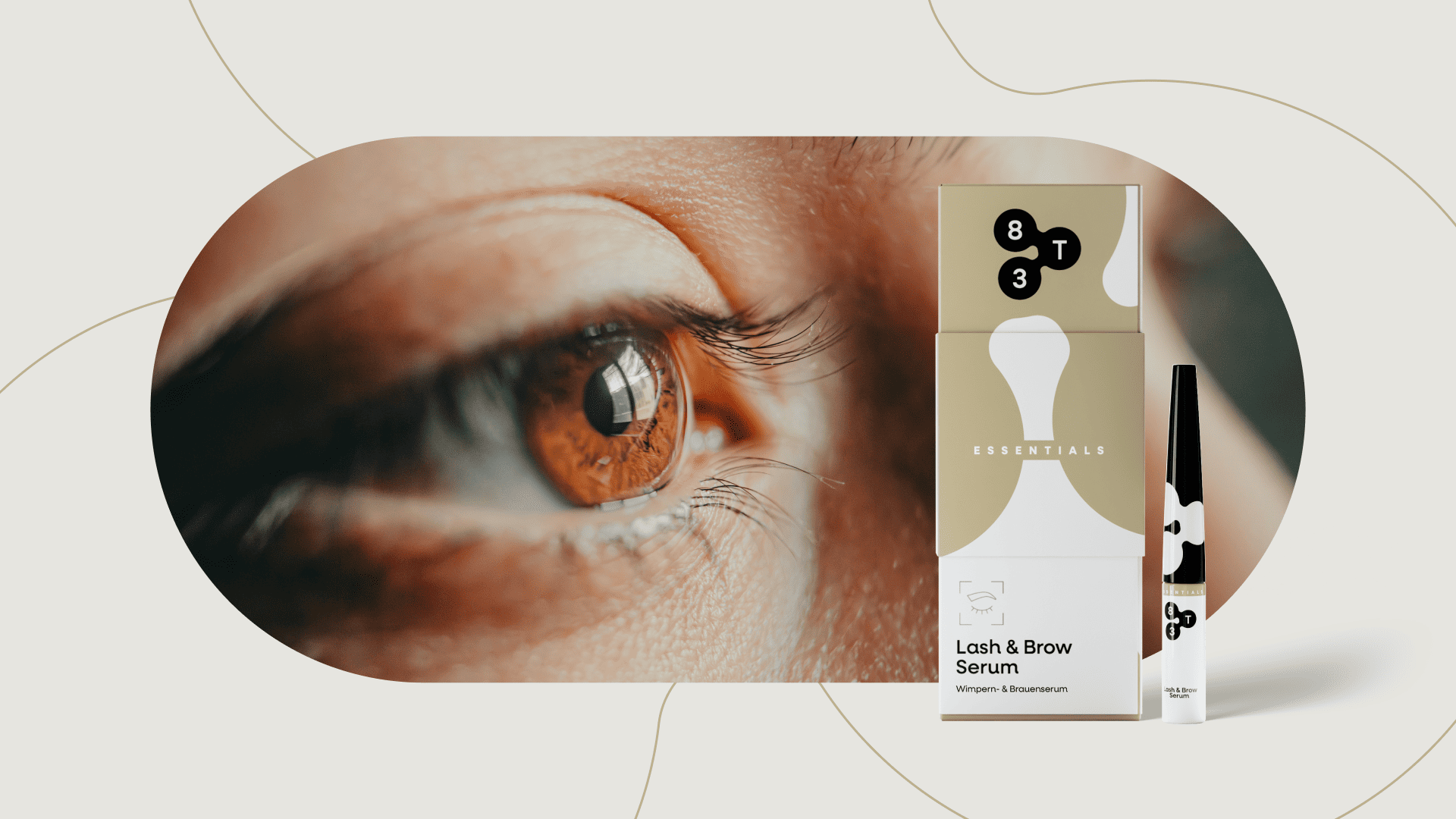
8T3 Essentials Lash & Brow Serum—a different approach to lash growth.
This is exactly where the 8T3 Essentials Lash & Brow Serum comes in.
Instead of mimicking the mechanism of prostaglandins, 8T3 deliberately chose a different approach. At its core is MAL-838, a form of sCD83, a protein that occurs naturally in the human body. The mechanism of action developed by 8T3 targets processes in the environment of the hair follicle—and with them, the conditions under which hair grows.
This is a fundamentally different principle from that of a lash serum with prostaglandin analogs.
What makes the 8T3 serum different.
The formula itself is also deliberately minimal. The hormone-free lash serum from 8T3 Essentials contains no prostaglandin analogs or hormones. It is also free of alcohol, fragrance, parabens, and silicones, and it is vegan and pH-neutral. Its tolerability has been dermatologically tested. In 2025, the serum was also certified as microbiome-friendly.
Application is simple. Once a day in the evening, apply a small amount along the clean upper lash line, like a fine stroke of eyeliner. If your eye area is particularly sensitive, 8T3 recommends starting with just two to three applications per week.
What the 12-week study shows.
In the end, what matters is not just what an ingredient can do in theory, but what can actually be observed in use.
That is why the 8T3 Essentials Lash & Brow Serum was evaluated over twelve weeks in a consumer use study with 21 women aged 20 to 65. The participants used the serum once a day. Changes were documented after four, eight, and twelve weeks, through self-assessments and, additionally, standardized Canfield image analysis. The results of the 12-week study:
- After twelve weeks, 81% of participants reported longer or significantly longer lashes.
- After four weeks, the figure was already 67%, and after eight weeks, 76%.
- Perceived strengthening took a little more patience: after twelve weeks, 53% described their lashes as stronger.
- For individual participants, the computer-assisted image analysis showed increases of up to 39% in length and up to 32% more intensity.
Tolerability is also worth noting: during the twelve-week study period, no irritation of the conjunctiva, iris discoloration, or new dark circles under the eyes were observed under dermatological supervision. Individual reactions nevertheless remain possible.
What do customers say about the 8T3 Essentials Lash & Brow Serum?
Alongside the results of the 12-week consumer use study, feedback from users offers insight into how the serum performs in everyday life. Verified reviews on Trusted Shops highlight, among other things, fuller and longer lashes, good tolerability, and easy application. At the same time, the feedback shows that experiences always vary from person to person.

Sehr einfach aufzutragen und sichtbare Wirkungen bei mir nach 6 Wochen!!!
You can find more reviews and user experiences with the 8T3 Essentials Lash & Brow Serum on our reviews page.
Beautiful lashes, with a closer look at the ingredients.
When it comes to a beauty product you apply right next to your eye night after night, it pays to take a second look at the ingredients.
Prostaglandin analogs can make lashes grow visibly. But their strong biological effect has a downside: side effects affecting the eyes and the eye area are documented, and the European safety assessment is now clearly critical. The European Commission is working on a corresponding ban for cosmetic products.
For you, this does not mean giving up on lash serums. It means choosing more carefully. A prostaglandin-free lash serum should have a transparent formula, be well tolerated, and, wherever possible, back up its claims with verifiable data.
The 8T3 Essentials Lash & Brow Serum takes a prostaglandin-free and hormone-free approach with MAL-838. The 12-week consumer use study provides initial concrete data on what this approach can do—without turning that into a promise for every individual user.
Perhaps that is the more modern take on beauty: not maximum effect at any cost, but knowing what you use, why it works, and what science is behind it.
Frequently asked questions about lash serums without prostaglandin analogs
Sources:
- https://health.ec.europa.eu/publications/sccs-prostaglandin-analogues-methylamido-dihydro-noralfaprostal-mdn-isopropyl-cloprostenate-ipcp_en
- https://technical-barriers-trade.ec.europa.eu/en/notification/39957
- https://pubmed.ncbi.nlm.nih.gov/12204716/
- https://pubmed.ncbi.nlm.nih.gov/20384750/
- https://www.accessdata.fda.gov/drugsatfda_docs/pediatric/22369_Bimatoprost_Clinical_PREA.pdf
- https://www.canada.ca/en/health-canada/services/consumer-product-safety/cosmetics/cosmetic-ingredient-hotlist-prohibited-restricted-ingredients.html
- https://www.tga.gov.au/sites/default/files/auspar-bimatoprost-140718.pdf
- https://www.lgl.bayern.de/gesundheit/arzneimittel/warnungen_verbraucherinformationen/warnungen/prostaglandin_haltige_wimpernwachstumsseeren.htm
Similar posts

Perfect eyebrows: shape, care, and methods at a glance

How to get longer eyelashes: What really works – from care to serums
81% confirm longer eyelashes: Results of a 12-week study

4-5 Sterne – Inhaltlich top, Ausfall scheinbar gestoppt! Das Produkt ist meine letzte Chance, ansonsten lebe ich mit der Glatze – eine Haartransplantation in der Türkei kommt für mich nicht infrage. Mein Vater hatte schon früh Haarausfall und bei mir fängt es jetzt leider auch an. Vielleicht ist es für eine finale Bewertung noch etwas zu früh, aber ich meine schon zu erkennen, dass sich ganz kleine neue Haare bilden. Was aber jetzt schon deutlich wird – und das ist für mich bereits ein riesiger Erfolg: Der Haarausfall scheint gestoppt zu sein! Ich gebe nach 6 Monaten Nutzung noch einmal eine finale Abschlussbeurteilung ab. Bis jetzt sehr zufrieden!